Choosing a custom silicone hose manufacturer is an important decision for OEM companies, automotive parts suppliers, industrial equipment manufacturers, and product developers. A silicone hose may look like a simple component, but its performance depends on several factors, including material formulation, reinforcement structure, operating temperature, pressure requirements, and manufacturing accuracy.
Not every silicone hose supplier has the engineering experience or production capabilities to handle customized designs. Some manufacturers focus on standard automotive hoses, while others can produce complex shapes, reinforced structures, specialized inner linings, and application-specific assemblies.
So, how do you choose the right custom silicone hose manufacturer? Start by evaluating the manufacturer's material expertise, customization capabilities, quality control system, industry experience, and ability to provide products that match your actual operating conditions.
For international buyers, these factors are particularly important when sourcing silicone hoses for automotive cooling systems, turbochargers, fuel cell systems, industrial machinery, and other demanding applications.
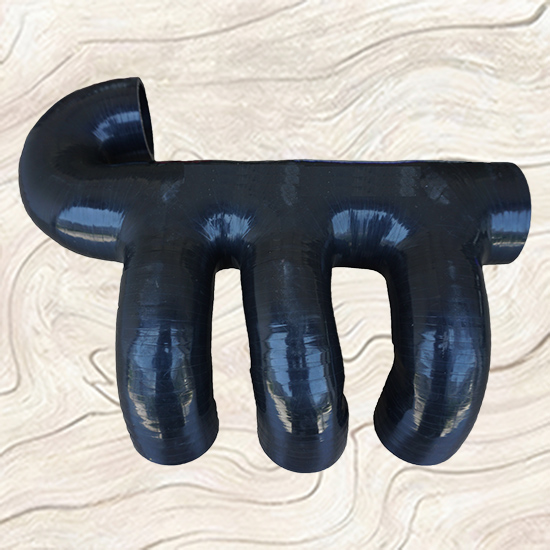
Custom-shaped silicone hose manufactured for specialized equipment applications.
Understand Your Application Before Choosing a Manufacturer
The first step is to define exactly how the silicone hose will be used. A hose designed for an automotive cooling system may have very different requirements from one used in a hydrogen fuel cell, food processing line, or industrial ventilation system.
Before contacting a manufacturer, consider the following application requirements:
- Operating temperature: What are the normal and maximum temperatures during operation? Is the hose exposed to rapid temperature changes?
- Working pressure: What pressure must the hose withstand? Are there pressure spikes, vacuum conditions, or repeated pressure cycles?
- Transported medium: Will the hose carry air, coolant, water, fuel, oil, hydrogen, or another substance?
- Installation environment: Will the hose be exposed to vibration, chemicals, UV radiation, ozone, moisture, or mechanical abrasion?
- Space and geometry: Does the installation require straight sections, elbows, reducers, hump connections, or complex molded shapes?
These details help determine whether standard silicone construction is suitable or whether a specialized material, reinforcement, or inner lining is needed.
RAINBOW Manufacturing produces customized silicone hoses for automotive, railway, shipbuilding, fuel cell, machinery, electronics, and other industrial applications. Its custom silicone hose design and manufacturing service allows buyers to discuss specific requirements based on drawings, samples, and application conditions.
Check the Manufacturer's Silicone Material Expertise
Silicone rubber is widely used in hose manufacturing because of its flexibility, thermal stability, weather resistance, and aging resistance. However, different silicone formulations and material constructions are developed for different operating environments.
A professional custom silicone hose manufacturer should understand how to select suitable materials rather than simply offer one standard silicone compound for every application.
Standard silicone rubber
Standard silicone rubber is commonly used in automotive air intake systems, coolant hoses, heater hoses, and general industrial applications. It provides flexibility and good resistance to temperature changes.
Fluorosilicone and FKM-lined constructions
When hoses are exposed to fuels, oils, or aggressive chemicals, the compatibility of the inner surface becomes particularly important. Fluorosilicone or fluororubber lining may be considered to improve resistance to specific transported media.
For example, RAINBOW manufactures Viton-lined silicone hoses that combine reinforced silicone construction with a specialized inner lining for demanding fuel cell and industrial applications.
Food-grade silicone
Food processing and beverage equipment require materials that meet the relevant food-contact requirements. Buyers should verify the exact material formulation, curing process, and applicable compliance documentation before approving a hose for food-contact use.
Specialized silicone compounds
Some applications require additional flame resistance, chemical resistance, or other application-specific properties. The correct material should be selected according to the complete operating environment rather than one performance characteristic alone.
Evaluate Reinforcement Options and Hose Construction
Material selection is only one part of custom silicone hose manufacturing. Reinforcement construction also has a significant influence on pressure resistance, dimensional stability, flexibility, and service performance.
Different reinforcement materials are suitable for different applications.
Polyester reinforcement
Polyester fabric is commonly used in multi-layer automotive silicone hoses. It helps maintain hose structure and provides mechanical support under specified operating conditions.
Aramid reinforcement
Aramid fibers offer high strength relative to their weight and can be used in hose designs that require additional mechanical reinforcement. The appropriate construction depends on pressure, temperature, and the required flexibility.
Glass fiber reinforcement
Glass fiber reinforcement is useful in selected high-temperature applications. It can be incorporated into specialized silicone hose constructions to improve structural stability under demanding thermal conditions.
Steel wire reinforcement
Steel wire can help maintain the shape of flexible silicone ducting and other hoses that require additional structural support, particularly in applications involving vacuum or airflow.
For projects with unusual installation requirements, RAINBOW offers different special-use silicone hose constructions, including aramid-reinforced, glassfiber-reinforced, and wire-reinforced options.

Reinforced silicone hose with a customized shape for specialized automotive applications.
When comparing manufacturers, ask whether they can explain the advantages and limitations of each reinforcement option for your particular application.
Make Sure the Manufacturer Can Handle Custom Shapes and Dimensions
Standard straight silicone hoses are suitable for many basic connections, but modern equipment often requires more complicated geometries.
A customized hose may need to fit around engine components, connect different pipe diameters, accommodate movement, or work within a limited installation space.
Common custom silicone hose designs include:
- Straight silicone hoses: Used for direct connections between components.
- 45-degree and 90-degree elbows: Designed to change the direction of airflow or fluid routing.
- Reducer hoses: Connect components with different diameters.
- Hump hoses: Help accommodate movement, vibration, and thermal expansion in suitable installations.
- Multi-branch hoses: Provide multiple connection points in a single customized component.
- Hoses with metal inserts: Combine silicone hose construction with metal connection components for specific assembly requirements.
A capable manufacturer should be able to review technical drawings or physical samples and assess whether the proposed geometry can be manufactured reliably.
RAINBOW's custom silicone couplers and connectors include straight hoses, reducers, elbows, hump hoses, and other shapes for automotive and industrial applications.
When submitting a drawing, include the inner diameter, outer diameter, overall length, bend angles, connection dimensions, and any special installation restrictions. This reduces unnecessary revisions during sample development.
Review Industry Experience and Application-Specific Products
A manufacturer with experience in your industry is more likely to understand the technical challenges involved in your project.
For example, automotive silicone hoses often need to withstand engine heat, vibration, coolant exposure, and pressure fluctuations. Fuel cell systems may require more specialized material compatibility and gas-permeation considerations. Railway applications may have additional fire performance requirements.
Before choosing a supplier, check whether its product portfolio matches your intended application.
Automotive applications
Automotive manufacturers and aftermarket suppliers commonly require turbocharger hoses, radiator hoses, charge air cooler hoses, air intake hoses, vacuum hoses, and heater hoses. These products need suitable dimensions, reinforcement, and material performance.
RAINBOW provides a range of vehicle silicone hoses for different automotive systems, including turbocharger, coolant, CAC, and air intake applications.
Hydrogen fuel cell systems
Fuel cell systems require careful material selection based on the transported gas, operating pressure, temperature, and system design. Hydrogen-related hose applications should be evaluated against the relevant permeation, leakage, compatibility, and safety requirements.
Food processing equipment
Food-grade silicone hoses are used in selected food, beverage, and pharmaceutical equipment applications. The material and finished product must meet the requirements applicable to the intended contact conditions.
Industrial machinery and transportation
Specialized industrial equipment may require flame-resistant, chemical-resistant, reinforced, or unusually shaped silicone hoses. A supplier with a broad product range can make it easier to develop a suitable solution.
Verify Quality Management and Product Testing Capabilities
Quality consistency is one of the most important factors when selecting a custom silicone hose manufacturer, especially for OEM projects involving repeated orders and long-term supply agreements.
A quality management certificate is a useful starting point, but buyers should also examine how the manufacturer controls materials, production processes, dimensions, and finished-product performance.
Important items to review include:
- Quality management certification: Check whether the manufacturer maintains an applicable ISO 9001 or automotive quality management certification.
- Material inspection: Confirm that incoming silicone compounds and reinforcement materials are checked against purchasing specifications.
- Dimensional inspection: Verify inner diameter, outer diameter, wall thickness, length, and connection geometry.
- Pressure testing: Determine whether the product requires burst, working-pressure, vacuum, or leak testing.
- Temperature testing: Review whether the hose has been evaluated under the relevant thermal conditions.
- Application-specific standards: Confirm that any claimed compliance applies to the exact product construction and intended application.
RAINBOW Manufacturing states that it is an ISO 9001-certified silicone hose manufacturer and provides products designed for various industry requirements. Its published company information also references standards and test documentation such as SAE J20, SAE J30, SAE J2006, EN 45545, UL 94 V-0, RoHS, REACH, and FDA-related requirements.
These standards are not interchangeable. For example, SAE J20 relates to engine coolant hose requirements, while SAE J30 addresses fuel and oil hose applications. Buyers should request the relevant product-specific reports rather than assume every hose meets every listed standard.
For more information about the company's manufacturing background and quality documentation, visit RAINBOW's company and quality information.
Understand the Custom Silicone Hose Manufacturing Process
A reliable custom hose supplier should have a clear process for moving from an initial design to an approved production order.
Although the exact process varies by hose construction, a typical custom manufacturing project includes the following stages.
Design review
The manufacturer reviews drawings, samples, dimensions, materials, operating conditions, and performance requirements. Any missing technical information should be clarified before production planning.
Material and construction selection
Based on the application, the manufacturer recommends an appropriate silicone compound, reinforcement structure, inner lining, and connection design.
Prototype or sample development
A sample is produced to check dimensions, appearance, fitment, and other agreed requirements. For more demanding applications, additional performance testing may be necessary.
Sample approval
The buyer reviews the sample against the agreed drawings and acceptance criteria. Any required changes should be documented before mass production.
Mass production and inspection
Once the sample is approved, the manufacturer proceeds with production and the agreed inspection procedures. Clear product specifications help maintain consistency between batches.
Packaging and delivery
Finished hoses are inspected, packed, and prepared for shipment according to the buyer's requirements.
For OEM and ODM buyers, a clearly defined development process helps reduce communication problems, unexpected tooling changes, and delays during product introduction.
Compare MOQ, Lead Time, and Total Purchasing Cost
Price is important, but choosing the lowest quotation does not always result in the lowest total purchasing cost.
When comparing custom silicone hose manufacturers, consider the following factors:
- Minimum order quantity: Check whether the supplier accepts prototype orders, small batches, or larger production runs.
- Tooling costs: Ask whether custom molds, fixtures, or development charges are required.
- Material costs: Specialized silicone compounds, reinforcement, and inner linings may affect the final price.
- Production lead time: Confirm sample development time, production scheduling, and delivery expectations.
- Quality requirements: Additional testing, inspection, and documentation may affect the project budget.
- Packaging and logistics: Consider export packaging, shipping arrangements, and delivery terms.
RAINBOW's published product listings show MOQ information of 10 pieces for several customized hose products, with typical listed lead times of 4–8 weeks. Actual quantities and delivery schedules should be confirmed according to the design, materials, order volume, and production requirements.
For distributors and private-label brands, the company also provides custom silicone hose branding and private-label services, including logo application and product marking options.
Questions to Ask Before Placing a Custom Silicone Hose Order
Before selecting a supplier, it is worth having a technical discussion rather than requesting a quotation based only on a product photo.
Here are some useful questions for OEM engineers and purchasing teams:
- Can you manufacture silicone hoses according to engineering drawings or physical samples?
- Which silicone compounds and reinforcement materials are available?
- Can you produce complex shapes, reducers, elbows, and multi-branch hoses?
- Can you recommend a suitable inner lining for fuel, oil, or chemical exposure?
- Which product-specific test reports and certifications can you provide?
- Can you develop samples before mass production?
- What are the MOQ, tooling costs, and estimated lead time?
- Can you provide OEM branding, custom colors, and permanent product marking?
A manufacturer's answers can reveal how well its engineering and production teams understand the requirements of your project.
Why Choose RAINBOW as Your Custom Silicone Hose Manufacturer?
For buyers looking for a custom silicone hose manufacturer in China, RAINBOW Manufacturing offers a product portfolio covering automotive, fuel cell, transportation, food-grade, and specialized industrial applications.
Established in 2009, RAINBOW has developed experience in performance silicone hoses and silicone molded parts. Its manufacturing capabilities support different hose constructions, customized geometries, and application-specific product requirements.
Key reasons to consider RAINBOW include:
- Broad product range: Vehicle silicone hoses, fuel cell hoses, special-use hoses, silicone couplers, and food-grade silicone hoses.
- Custom manufacturing: Products can be developed around customer drawings, samples, and technical requirements.
- Reinforcement options: Different reinforced constructions are available for applications with specific mechanical and thermal demands.
- Specialized materials: Options include fluorosilicone-lined and fluororubber-lined hose constructions.
- Quality management: ISO 9001 certification and relevant product documentation support quality evaluation.
- OEM support: Custom colors, logo application, and permanent part marking are available for selected projects.
RAINBOW custom silicone hose solutions for OEM and industrial customers.
Whether you need a custom turbocharger hose, reinforced coolant hose, fuel cell hose, or a specialized silicone component, RAINBOW can review your drawings and discuss a suitable manufacturing solution.
If you are developing a new product or looking for a long-term silicone hose supplier, explore RAINBOW's silicone hose product catalog or contact the team with your drawings, samples, and technical specifications.
A well-matched manufacturing partner can help you improve product fit, maintain consistent quality, and build a more reliable supply chain for your business.
Frequently Asked Questions About Custom Silicone Hose Manufacturers
How do I choose a reliable custom silicone hose manufacturer?
Evaluate the manufacturer's material expertise, reinforcement options, custom design capabilities, quality management system, industry experience, product testing, and ability to manufacture according to drawings or samples. Also confirm MOQ, lead time, and technical support before placing an order.
What information should I provide when requesting a custom silicone hose quotation?
Provide engineering drawings or samples, inner and outer diameters, overall length, bend angles, operating temperature, working pressure, transported medium, reinforcement requirements, order quantity, and any relevant industry standards.
Can a manufacturer produce silicone hoses according to drawings?
Yes. Custom silicone hose manufacturers can review engineering drawings or physical samples to develop products with specific dimensions, shapes, connections, and reinforcement structures. A sample approval process is recommended before mass production.
What is the difference between standard and reinforced silicone hoses?
Standard silicone hoses use silicone rubber as the main construction material, while reinforced versions incorporate materials such as polyester, aramid, glass fiber, or steel wire to provide additional mechanical support. The appropriate construction depends on the operating pressure, temperature, and installation requirements.
Can silicone hoses withstand high temperatures?
Silicone hoses are widely used in high-temperature applications because of their thermal stability. However, the actual continuous and intermittent temperature limits depend on the silicone compound, reinforcement, hose construction, and operating conditions. Always check the manufacturer's product-specific specifications.
Are silicone hoses suitable for fuel and oil applications?
Not all standard silicone hoses are suitable for direct contact with fuels and oils. Specialized constructions using fluorosilicone or fluororubber inner linings may be considered, subject to compatibility testing and the requirements of the transported medium.
What certifications should I check when buying custom silicone hoses?
Depending on the application, relevant documentation may include ISO 9001, IATF 16949, SAE J20, SAE J30, SAE J2006, EN 45545, UL 94, RoHS, REACH, and applicable FDA food-contact requirements. Confirm that each certificate or test report applies to the specific product.
What is the typical MOQ for custom silicone hoses?
MOQ varies according to the product design, materials, tooling, and manufacturing process. Some RAINBOW product listings specify an MOQ of 10 pieces. Buyers should confirm the MOQ for their particular custom design.
How long does custom silicone hose manufacturing take?
Lead time depends on sample development, tooling, material availability, order quantity, and production scheduling. Several RAINBOW product listings indicate a typical lead time of 4–8 weeks, subject to project confirmation.
Can RAINBOW provide OEM and private-label silicone hoses?
Yes. RAINBOW offers customization options including product colors, logo application, and permanent part marking. OEM buyers can discuss their branding and technical requirements directly with the manufacturer.