EV thermal management systems place conflicting demands on cooling hoses. Engineers must balance low-temperature flexibility, high-temperature resistance, coolant compatibility, pressure cycling, vibration and long service life in compact packaging. Many teams struggle to decide between silicone, EPDM and PA for different cooling circuits. Choosing the wrong material can lead to premature hose failure, coolant contamination or costly redesign late in the project. This article provides a practical, application-focused comparison to support material selection for electric vehicle silicone hose and related cooling circuits.
Key Takeaways
- Silicone, EPDM and PA each have distinct temperature, pressure and chemical compatibility profiles in EV cooling circuits.
- Battery and motor cooling loops often have different material priorities than high-pressure or highly integrated coolant lines.
- Hose material should be matched to circuit function, not selected only by maximum temperature rating.
- System-level requirements such as conductivity control, vibration resistance and packaging space can override simple material preferences.
EV Thermal Management Circuits and Hose Requirements
Typical EV cooling architectures include several distinct circuits. Battery cooling and heating loops operate at low to moderate pressure with tight temperature control. Some designs use low-conductivity coolants to reduce electrical risk. Motor and inverter cooling circuits experience moderate pressure, significant temperature cycling and continuous vibration from the drivetrain. Heat pump and cabin heating systems may use coolant or refrigerant depending on the vehicle architecture. OBC and DC-DC converter cooling typically involves lower flow rates but high reliability requirements.
Key hose performance factors in these circuits include continuous and peak temperature range, working pressure and pressure cycling, coolant type and compatibility, electrical considerations such as conductivity and leakage risk, and mechanical loads from vibration, movement and tight packaging. Material choice must follow circuit function, not a single best material rule for all EV thermal management applications.
Silicone Coolant Hoses in EV Applications
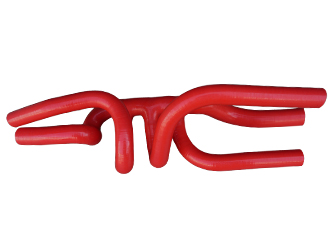
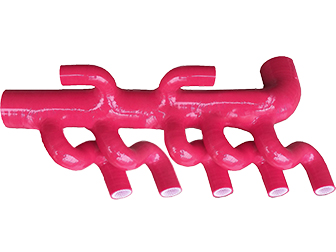
Silicone coolant hose offers several characteristics that align well with demanding EV thermal environments. It provides a wide continuous temperature range and maintains flexibility at very low temperatures. Thermal aging resistance and compression set performance are generally superior to many conventional elastomers. These properties make silicone suitable for complex routing and custom shapes in confined engine bays and battery enclosures.
Common use cases in EVs include battery cooling and heating circuits where temperature cycling is significant, motor and inverter cooling lines that require flexible routing in tight spaces, and heater or heat-pump related coolant lines in some architectures. Reinforced constructions using polyester, aramid, fiberglass or wire can be used to tune pressure resistance and dimensional stability for specific circuits.
Limitations should be acknowledged. Silicone has higher permeability to certain fluids compared with multi-layer PA constructions. Cost can be higher than standard EPDM in less demanding circuits. Compatibility with specific low-conductivity coolants and additive packages should be verified through testing. For teams specifically evaluating electric vehicle silicone hose options, the key is to map hose types to circuit function: coolant lines for battery and motor cooling, heater hoses for cabin and thermal conditioning, and custom assemblies for compact routing.
EPDM Coolant Hose in Electric Vehicles
EPDM remains widely used in EV cooling systems. It offers a good balance of coolant compatibility, temperature resistance and cost. The supply chain is mature and long-term behavior in water-glycol systems is well understood. Typical applications include conventional coolant circuits in battery and motor cooling where temperature and pressure are moderate, HVAC heater core hoses and some heat pump related lines.
Limitations in the EV context include lower continuous temperature capability compared with high-grade silicone, less flexibility at very low temperatures which can affect routing in cold climates, and the need for additional design margin in high temperature zones near power electronics. Where higher temperature or flexibility is required, electric vehicle silicone hose may be considered instead of EPDM in selected circuits.
PA and Nylon Coolant Hose for Battery and Motor Cooling
PA and multi-layer PA-based constructions play a specific role in EV thermal systems. They provide high pressure resistance and low permeability. Dimensional stability is good, making them suitable for compact, highly integrated cooling modules. Typical use cases include high-pressure sections of battery cooling circuits, integrated cooling plates and manifold connections where rigid or semi-rigid lines are preferred, and applications where space constraints favor smaller bend radii and tight packaging.
Trade-offs versus flexible rubber and silicone hoses include lower flexibility, which can make assembly and service more challenging in some layouts, and different failure modes such as cracking under repeated flexing or sensitivity to certain chemicals. Flexible EV thermal management silicone hose is often used in conjunction with PA lines to connect moving components or absorb vibration, creating a mixed-material system that leverages the strengths of each material.
Practical Material Selection Guidelines
Material selection should start from circuit function: battery, motor, inverter, heat pump, OBC or DC-DC. Define temperature, pressure, coolant type and electrical requirements first. Then evaluate silicone, EPDM and PA against those requirements, not against each other in isolation. Common pitfalls include selecting material only by maximum temperature while ignoring pressure cycling and vibration, assuming one material can cover all circuits in an EV thermal system, and overlooking coolant compatibility and long-term aging in low-conductivity fluids.
In complex systems, a mixed-material approach is often the most robust solution. PA can handle high-pressure sections, while flexible hoses provide routing flexibility and vibration isolation. Industry guidance from organizations such as SAE emphasizes system-level design rather than component-level optimization alone. If you are evaluating materials for a specific cooling circuit, sharing your temperature, pressure, coolant type and packaging constraints early can help identify the most suitable hose construction. Rainbow's engineering team can discuss silicone, EPDM and PA options for your EV thermal management project and support custom hose development where required.
FAQ
Is silicone hose suitable for all EV cooling circuits?
No. Suitability depends on pressure level, coolant type, temperature profile and system architecture. Silicone is often preferred in circuits with significant temperature cycling and complex routing, while PA may be favored in high-pressure sections.
What temperature range can silicone coolant hoses typically cover in EV applications?
Typical continuous operating ranges span approximately -55°C to +250°C depending on compound and reinforcement. Peak temperatures may be higher for short durations. Specific values should be confirmed with the hose supplier for the intended coolant and service conditions.
When is PA preferred over flexible rubber or silicone hoses in EV thermal management?
PA is often selected for high-pressure sections, low permeability requirements and highly integrated cooling modules where compact packaging is critical. Flexible hoses are then used for routing, vibration isolation and connection to moving components.
Does coolant conductivity affect hose material selection in battery cooling?
Yes. Low-conductivity coolants used in some battery cooling designs require careful evaluation of hose materials, additives and system cleanliness to maintain electrical safety over the vehicle lifetime.
Can different hose materials be used in the same EV thermal system?
Yes. Mixed-material systems combining PA, silicone and EPDM are common and often optimal. Each material is applied where its properties best match the circuit requirements.