Turbocharged engines expose intake hoses to elevated temperatures, internal pressure and continuous vibration. These conditions can affect material properties, hose expansion and connection stability. A component that performs well under one condition may not remain suitable when heat and pressure act together.
Selecting the right silicone turbo hose requires an understanding of how temperature, reinforcement and installation geometry influence performance. For engineers and automotive parts buyers, the key is to evaluate the complete hose construction against the actual operating environment.
Key Takeaways
- Continuous heat exposure and short-term temperature peaks impose different demands on hose materials.
- Boost pressure creates mechanical loads that can cause expansion and stress at connection points.
- Reinforcement construction influences pressure resistance, flexibility and dimensional stability.
- Temperature and pressure capabilities must be assessed under the intended operating conditions.
What Are Silicone Turbo Hoses Used For?
These hoses are commonly used to carry compressed air through a turbocharged engine's intake system. Typical locations include the connection between the turbocharger and intercooler, and the pipework between the intercooler and engine intake.
The operating conditions can differ considerably between these locations. Air leaving the compressor is generally hotter than air leaving an intercooler, although actual temperatures depend on boost level, cooling efficiency and engine operation.
The surrounding environment also matters. A hose installed near a turbine housing or exhaust component may experience substantial external heat even when the air inside it is comparatively cooler.
These differences affect the required material properties, reinforcement and geometry. Application position should therefore be considered alongside the system's operating pressure and temperature rather than treating every intake connection as an identical application.
How Does High Temperature Affect Hose Performance?
A high temp silicone hose is selected partly for its ability to retain useful properties under elevated temperatures. However, the material's general heat resistance does not establish the operating limits of every finished product.
Continuous temperature and short-term peaks
Continuous operating temperature describes sustained exposure under specified conditions. Short-term peak temperature refers to brief exposure to a higher temperature. These limits are not interchangeable.
Prolonged exposure to excessive heat can accelerate material degradation and affect flexibility, strength and service life. The extent of these changes depends on the silicone formulation, hose construction, exposure duration and operating environment.
Repeated temperature peaks also deserve attention. A component that tolerates occasional brief exposure may not be suitable for the same temperature maintained continuously.
Engineers should distinguish normal operating temperatures from transient peaks and verify that the product specification addresses both conditions where necessary.
Heat from surrounding components
Internal air temperature is only one part of the thermal environment. Radiation and convection from nearby turbocharger and exhaust components can raise the temperature of the outer surface.
This can create a temperature difference between the inner and outer walls. Installation clearance, surrounding airflow and heat shielding may influence the resulting exposure.
Consequently, the engine's general operating temperature is not a reliable substitute for assessing the thermal conditions at the hose itself.
Material limitations
Silicone offers useful heat resistance and flexibility, but its performance depends on the specific formulation and finished construction. A material's published temperature range should not automatically be interpreted as the guaranteed service limit of a reinforced assembly.
The relevant specifications should identify the applicable continuous temperature and any intermittent exposure limits. The reinforcement and complete structure must also remain suitable for those conditions.
How Does Boost Pressure Affect Hose Performance?
Temperature resistance alone is insufficient for a pressurized intake connection. Internal boost pressure creates mechanical loads that the hose wall and reinforcement must withstand.
Internal pressure and expansion
Internal pressure produces stress in the hose wall and tends to increase its diameter. Excessive expansion can alter the intended geometry and place additional loads on connections.
Reinforcement helps restrain this expansion. Its effectiveness depends on the material, weave or construction, layer arrangement and integration with the silicone wall.
Pressure capability therefore depends on the complete construction rather than the silicone compound alone. Wall thickness and reinforcement must be evaluated together with the finished dimensions and applicable test data.
Pressure fluctuations and repeated loading
Boost pressure changes with engine speed, throttle position and turbocharger operation. The hose may experience repeated pressure cycles rather than a constant load.
These fluctuations can contribute to fatigue, particularly when combined with engine vibration, bending or movement at connection points.
The relevant operating conditions include normal boost pressure, expected peaks and significant pressure cycling. A maximum pressure figure should not automatically be treated as a recommended continuous operating limit unless the specification explicitly defines it that way.
Connection stability
The connection can become a weak point even when the hose wall has adequate pressure capability. Incorrect dimensions, poor alignment, insufficient insertion length or unsuitable clamping can increase the risk of leakage or displacement.
The hose, fitting and clamp should be assessed as a connected assembly. This is particularly important where pressure fluctuates or the engine moves relative to the surrounding components.
How Do Temperature and Boost Pressure Interact?
Heat and internal pressure should not be assessed as completely independent factors. Material properties can change with temperature, while pressure places mechanical stress on the hose wall and reinforcement.
When elevated temperatures coincide with repeated pressure changes, vibration and engine movement, the component must accommodate several interacting loads.
Three considerations are particularly important.
Pressure capability at operating temperature: A pressure test performed at room temperature does not automatically establish the same capability at elevated temperatures. The test conditions must be relevant to the intended application.
Reinforcement suitability: The structure must provide appropriate dimensional stability without making the hose too rigid for the required routing. Additional reinforcement is not automatically beneficial if it compromises the flexibility needed for installation.
Mechanical loads from installation: Tight bends, misaligned connections and contact with nearby components can introduce additional stress. Heat and pressure may make these existing design weaknesses more significant over time.
The key engineering question is whether the complete construction can withstand the specified combination of temperature, pressure and mechanical loading, rather than whether it passes a single isolated test.
How Does Reinforcement Construction Influence Performance?
Reinforcement provides mechanical support to the silicone structure, helping control expansion and maintain the intended shape under pressure. Its design also affects flexibility and the space required for installation.
Several factors influence the resulting performance:
Reinforcement material: Different fibers have different thermal and mechanical characteristics. Selection depends on the operating environment and required pressure capability.
Layer arrangement: The number and configuration of layers affect how loads are distributed through the wall.
Wall thickness and geometry: These influence deformation, bending behavior and installation clearance.
Manufacturing consistency: Variations in reinforcement placement, bonding and finished dimensions can affect the performance of the completed product.
Polyester and aramid are examples of materials used in reinforced silicone hose construction. Neither should be assumed to provide a particular pressure rating without supporting specifications.
Similarly, a higher ply count does not necessarily indicate a higher usable pressure limit. The overall structure and relevant test results are more informative than any single construction detail.
How Do Hose Geometry and Connections Affect Performance?
The shape of an intake hose influences both installation and the mechanical loads acting on it.
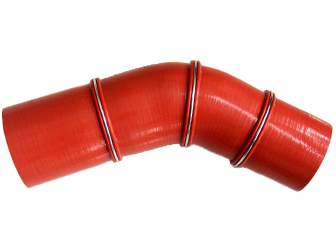
Straight couplers, elbows, reducers and hump-style connectors serve different layout requirements. Elbows accommodate directional changes, reducers connect different diameters, and suitable flexible connectors can accommodate movement in some installations.
However, geometry must remain compatible with the pressure and temperature requirements.
A bend that is too tight can cause local deformation or interfere with the intended shape. Misaligned connections may introduce bending loads, while insufficient clearance can allow contact with adjacent components as the engine moves.
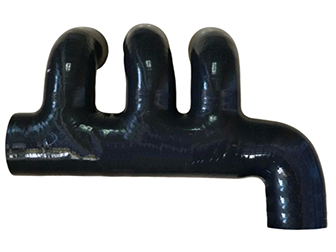
Where standard shapes cannot accommodate the available space, a custom silicone turbo hose may be appropriate. Offset sections, diameter transitions and specific bend angles can help address packaging constraints, but the finished design must still be evaluated for its intended operating conditions.
With 16 years of experience as a silicone hose manufacturer, Rainbow serves customers across multiple industries with a variety of silicone hose products. To explore product details relevant to this topic, visit Rainbow's silicone turbo hose page.
FAQ
How to choose the right silicone turbo hose for my vehicle?
Match the component to its installation position, internal diameter, connection dimensions, operating temperature and boost pressure. Also consider bend geometry, nearby heat sources and engine movement. Modified systems may require additional checks because their operating conditions can differ from the original design.