The Core Problem in Modern Drying Processes
In many manufacturing industries, especially electronics, adhesives, and industrial components, traditional drying methods often suffer from low efficiency, inconsistent results, and heavy reliance on manual handling. Batch ovens require repeated loading and unloading, causing downtime and uneven heating. This leads to unstable product quality and increased labor costs.
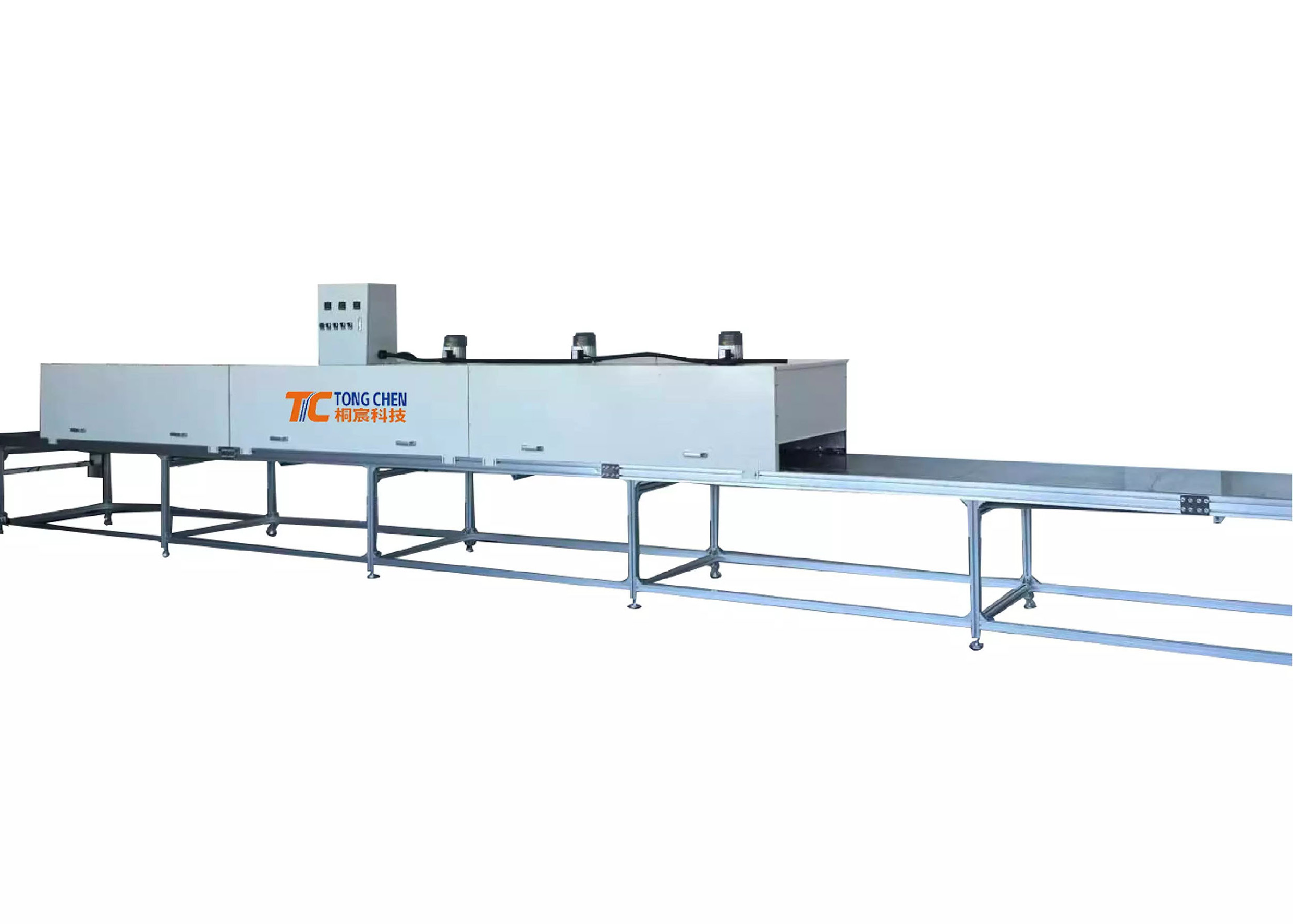
The Conveyor Type Drying Oven—also known as a Tunnel Dryer—is designed specifically to eliminate these inefficiencies. By integrating a continuous conveyor system with a controlled heating environment, it ensures seamless processing and consistent drying results.
How the System Works in Real Production Scenarios
The Belt Conveyor Tunnel Oven operates by moving products through a heated chamber via a motor-driven conveyor belt. During this process, the drying or curing cycle—adjustable between 10 to 15 seconds—is completed without interruption.
For example, in an electronics factory, after AB adhesive is dispensed onto components, the products are immediately transferred into an Automatic Conveyor Tunnel Furnace. As they move through the oven, the adhesive is rapidly cured, eliminating waiting time and ensuring uniform bonding strength.
In another scenario, small industrial parts requiring surface drying after coating can be continuously processed without manual intervention, significantly improving throughput.
Key Features That Drive Performance
This Industrial Continuous Drying Oven is designed with productivity and reliability in mind:
Continuous belt conveyor system for uninterrupted operation
Motor-driven transmission ensures stable and consistent movement
Adjustable drying cycle (10–15 seconds) for flexible process control
Compact machine size (1100×1000×1500mm) suitable for production lines
Stable operating parameters ensuring consistent drying results
These features allow manufacturers to maintain high output while ensuring product quality remains uniform.
Comparison with Traditional Drying Methods
Compared to traditional batch ovens, the Continuous Drying Oven offers significant advantages:
Efficiency: Continuous processing eliminates downtime between batches
Consistency: Uniform heating ensures identical results across all products
Labor Savings: Reduced manual handling lowers labor costs
Process Integration: Easily integrates into automated production lines
Traditional ovens may still be suitable for small-scale production, but for high-volume manufacturing, a Conveyor Type Drying Oven provides a clear competitive edge.
Frequently Asked Questions (Q&A)
Q1: What products are suitable for this machine?
A: It is ideal for products requiring baking or curing, such as adhesive-bonded components, coated parts, and electronic assemblies.
Q2: Can the drying time be adjusted?
A: Yes, the cycle can be adjusted between 10–15 seconds depending on process requirements.
Q3: Is it suitable for automated production lines?
A: Absolutely. The machine is designed for seamless integration into automated conveyor systems.