Industrial Ceramic Technology
Industrial ceramics refers to all ceramic materials, excluding daily-use ceramics, decorative ceramics, and building and sanitary ceramics, that can be used in industry and other sectors. It includes Industrial Ceramic products made using traditional techniques and fine ceramic materials made using advanced technologies and new processes.
In modern engineering, industrial ceramics are often referred to as Advanced Ceramic, Technical ceramics, or Engineering Ceramics. These materials use refined, high-purity, ultrafine, artificially synthesized inorganic compounds as raw materials, and are fired using precisely controlled preparation processes, resulting in specific properties.
Difference from Traditional Ceramic
| Comparison Items | Traditional Ceramic | Industrial Ceramic/Advanced ceramic |
| Raw Material | Natural minerals and clay | High-purity synthetic powder |
| Process | Simple molding, conventional sintering | Precision control molding, high-temperature sintering, hot isostatic pressing |
| Performance | General mechanical properties, high brittleness | High strength, high toughness, and designability |
| Accuracy | Large dimensional tolerances | Precision machining, micron-level accuracy |
| Application | Daily necessities, architecture, decoration | High-tech industries, aerospace, and biomedicine |
| Cost | Low | High (but excellent performance-to-cost ratio) |
Core Features
Compared to traditional metal materials, industrial ceramics have the following unique properties.
| Performance Category | Specific features | Engineering significance |
| Mechanical Properties | High hardness, high strength, and high wear resistance | Suitable for wear-resistant parts such as cutting tools and bearings |
| Thermal Properties | High temperature resistance, low thermal expansion, and excellent thermal stability | Suitable for high-temperature furnaces, heat exchangers, and aerospace components. |
| Chemical Properties | Corrosion resistant, acid and alkali resistant, oxidation resistant | Applicable to chemical equipment and medical devices |
| Electrical Properties | Excellent electrical insulation properties (partially exhibiting electrical, piezoelectric, and superconducting properties). | Suitable for electronic packaging, insulators, and sensors. |
| Physical Properties | Low density, lightweight, non-magnetic | Suitable for lightweight structures and precision instruments |
Main classification system
1.Classified by function (most commonly used)
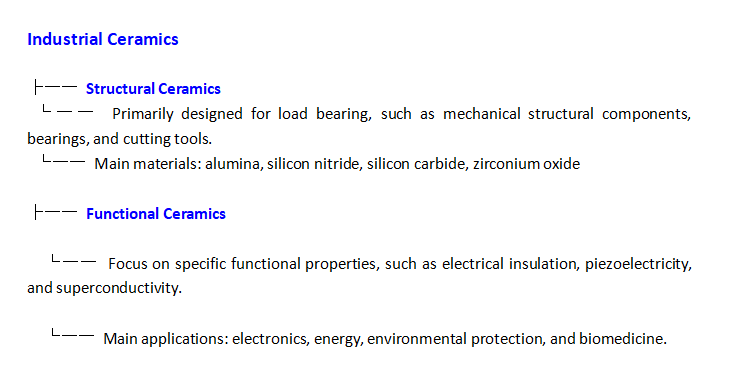
2. Classified by chemical composition
| Category | Representative Materials | Key Features | Typical applications |
| Oxide Ceramics | Aluminum oxide (Al₂O₃), zirconium oxide (ZrO₂), titanium oxide (TiO₂) | Antioxidant, chemically inert, electrically insulating, moderate thermal conductivity | Cutting tools, electronic substrates, biomedical implants |
| Non-oxide Ceramics | Silicon carbide (SiC), silicon nitride (Si₃N₄), boron nitride (BN) | Extremely high hardness, high thermal conductivity, and high-temperature strength (but poor oxidation resistance). | High-temperature structural components, wear-resistant parts, semiconductor devices |
| Composite Ceramics | Ceramic matrix composites (CMC), particle-reinforced ceramics | High toughness and adjustable overall performance | Aero engine components, high-performance cutting tools |
3.Classified by manufacturing process
(1)Slip Casting
(2)Hot Pressing
(3)Isostatic Pressing
(4)Injection Molding
Detailed About Some Main Materials
1. Alumina ceramics (Al₂O₃)
Purity grades: 75%, 85%, 95%, 99%, etc.
Characteristics: High hardness, excellent electrical insulation, relatively low cost
Applications: Electronic substrates, cutting tools, wear-resistant parts, crucibles
2.Zirconia ceramics (ZrO₂)
Properties: Highest toughness (transformation toughening), coefficient of thermal expansion close to that of steel
Applications: Ceramic bearings, dental implants, oxygen sensors, structural components
3.Silicon nitride ceramics (Si₃N₄)
Properties: Lightweight (density 3.2 g/cm³), high temperature resistance, self-lubricating
Applications: Bearing balls, engine parts, cutting tools
4.Silicon carbide ceramics (SiC)
Properties: Extremely high hardness (25 GPa), excellent thermal conductivity, and temperature resistance up to 1600°C
Applications: High-temperature heat exchangers, semiconductor devices, abrasives, bulletproof armor
Key Application Areas
According to the 2024-2025 industry report, the main applications of industrial ceramics include
| Application Areas | Typical Components/Equipment | Core Values |
| Aerospace | Turbine blades, thermal protection systems, spacecraft structural components | Lightweight and high temperature resistant |
| Automobile Manufacturing | Engine components, turbocharger, braking system | Improve efficiency and reduce energy consumption |
| Electronic Information | Integrated circuit substrates, packaging materials, and sensors | Insulation and high-frequency performance |
| Energy and Environmental Protection | Fuel cells, solar cells, nuclear reactor components | Corrosion resistance and high temperature stability |
| Medical Devices | Artificial joints, dental implants, surgical instruments | Biocompatibility, abrasion resistance |
| Mechanical Manufacturing | Bearings, seals, valves, cutting tools | Long lifespan, maintenance-free |
| Chemical Metallurgy | Corrosion-resistant pumps and valves, reactor linings, and refractory materials | Resistant to strong corrosion and thermal shock |
As a Technical Ceramics Manufacturers specializing in the R&D, production, and customization,Dongguan Xinzhida Technology(W7) focuses on core categories such as alumina ceramics and zirconia ceramics. We provide high-quality customized industrial ceramic parts and one-stop solutions tailored to the diverse working conditions of our global clients. Whether it's precision components for precision machinery or high-end ceramic components for semiconductors, we leverage our professional technology and stringent quality control to help global clients enhance their product competitiveness and jointly drive the upgrading of the high-end manufacturing industry.